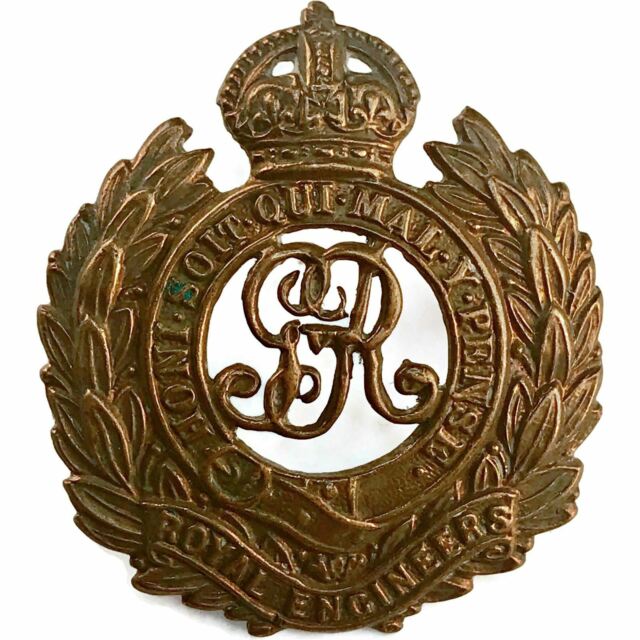
128th Field Company, The Royal Engineers joined 23rd Division in April 1915 at Shorncliffe, Kent. Some of the infantry were engaged in constructing defences to the south of London in April and May, before the Division moved to Bordon, Hampshire at the end of the month.
They proceeded to France in the third week of August, landing at Boulogne and concentrating near Tilques. On the 5th of September 23rd Division became attached to III Corps, moving to the Merris-Vieux Berquin area, for trench familiarisation under the guidance of the 20th (Light) and 27th Divisions.
They took over front line sector between Ferme Grande Flamengrie to the Armentieres-Wez Macquart road in their own right on the 14th. During the Battle of Loos CIII and CV Brigades RFA were in action attached to 8th Division. With 23rd Division holding the front at Bois Grenier, they were relieved from that sector at the end of January 1916 and Divisional HQ was established at Blaringhem with the units concentrated around Bruay for a period of rest. On the 3rd of March they returned to the front line, taking over a sector between the Boyau de l’Ersatz and the Souchez River from the French 17th Division, with the Artillery taking over an exposed position between Carency and Bois de Bouvigny where it was subjected to heavy shelling.

In early March a Tunnelling Company was established and men with a background in mining were transferred from the ranks to the Royal Engineers. In Mid April they returned to Bruay area for rest until mid May when they again took over the Souchez-Angres front, just before the German Attack on Vimy Ridge on the 21st. The brunt of the attack fell on 47th (London) Division, to the right of 23rd Division and the 23rd Divisional Artillery went into action in support of the 47th. On the 1st of June the Artillery supported 2nd Division as they undertook operations to recover lost ground. On the 11th of June the 23rd Division Infantry moved to Bomy and the artillery to Chamblain Chatelain and Therouanne to begin intensive training for the Battles of the Somme.
They were in action in The Battle of Albert including the capture of Contalmaison, The Battles of Bazentin Ridge, Pozieres, Flers-Courcelette, Morval and The Battle of Le Transloy including the capture of Le Sars. In 1917 they fought in The Battle of Messines, The Battles of the Menin Road, Polygon Wood and the The First and Second Battles of Passchendaele.
In November 1917 the Division moved to Italy concentrating between Mantua and Marcaria before taking over the front line at the Montello on the 4th of December. In 1918 they were in action during the fighting on the Asiago Plateau and the Battle of Vittorio Veneto, including the passage of the Piave and the Monticano. At the Italian Armistice at 3pm on the 4th of November, the 23rd were midway between the Rivers Livenza and Meduna, east of Sacile. They moved to billets west of Treviso and demobilisation took place in January and February 1919.
128th FIELD COMPANY R.E.
Ex-Service Association
RECORD
1960
Mr. T. C. Greenfield
How very sorry we are to record the passing of one of the original officers of the unit. Lieut T. C. Greenfield was Officer Commanding No. 2 section and was responsible for training and moulding of the section for service overseas. Unfortunately he happened to be one of our earliest casualties and was evacuated with a severe wound in the region of the lungs and his health has suffered as a consequence ever since.
During the Second World War he served as an Officer of the 1st Battalion of the Manx Home Guard in which he was a Company Commander. As a civilian he was employed for many years as Water Engineer to the Borough of Douglas, but in April, 1947 he was appointed Engineer to the All-Island Water Board. His passing was sudden and most unexpected whilst on a visit to his daughter at St. Asaph, Wales, during the first year of his retirement. He suffered an attack of coronary thrombosis whilst dressing on the morning of 2nd July, 1960.
Mr. Greenfield had always taken a keen interest in our association and he and Mrs. Greenfield have on many occasions attended our reunions accompanied by members of their family. Their son David, whom many of us have met, is at present engaged on supervising the installation of the turbo-generators at the Bharra dam, Punjab, India.
To Mrs. Greenfield, her two daughters and David we express our very deepest sympathy and we too mourn the loss of a staunch supporter and loyal friend.
 The Greenfields